
There is a particular kind of silence that falls over Oslo in December. The city does not close so much as contract, drawing inward like a hand into a woollen mitten. The streets empty early. The cafes fill with steam and candlelight. And in living rooms across the capital, people gather around fires to do something that has become increasingly rare in the modern world: they talk to each other, without phones, without agendas, without the tyranny of the urgent.
I was invited to one such gathering by Solveig Haugen, a retired literature professor who has hosted these fireside conversations every Friday for the past twenty years. Her apartment, on the top floor of a nineteenth-century building in the Grünerløkka district, smells of beeswax and cardamom and the particular mineral scent of a stone fireplace that has been burning for decades.
“In the winter, we do not have sunlight to guide us. We have only each other. The fire is not just warmth. It is a signal. It says: here, you are safe. Here, you may speak.”
The guests arrived in ones and twos, shaking snow from their boots, unwrapping scarves, accepting the cups of gløgg that Solveig's husband Erik ladled from a pot on the woodstove. There was a physician, a poet, a woman who restored antique furniture, and a young man who worked for the city's department of winter maintenance, a job title that, to an outsider, sounded like a branch of metaphysics.
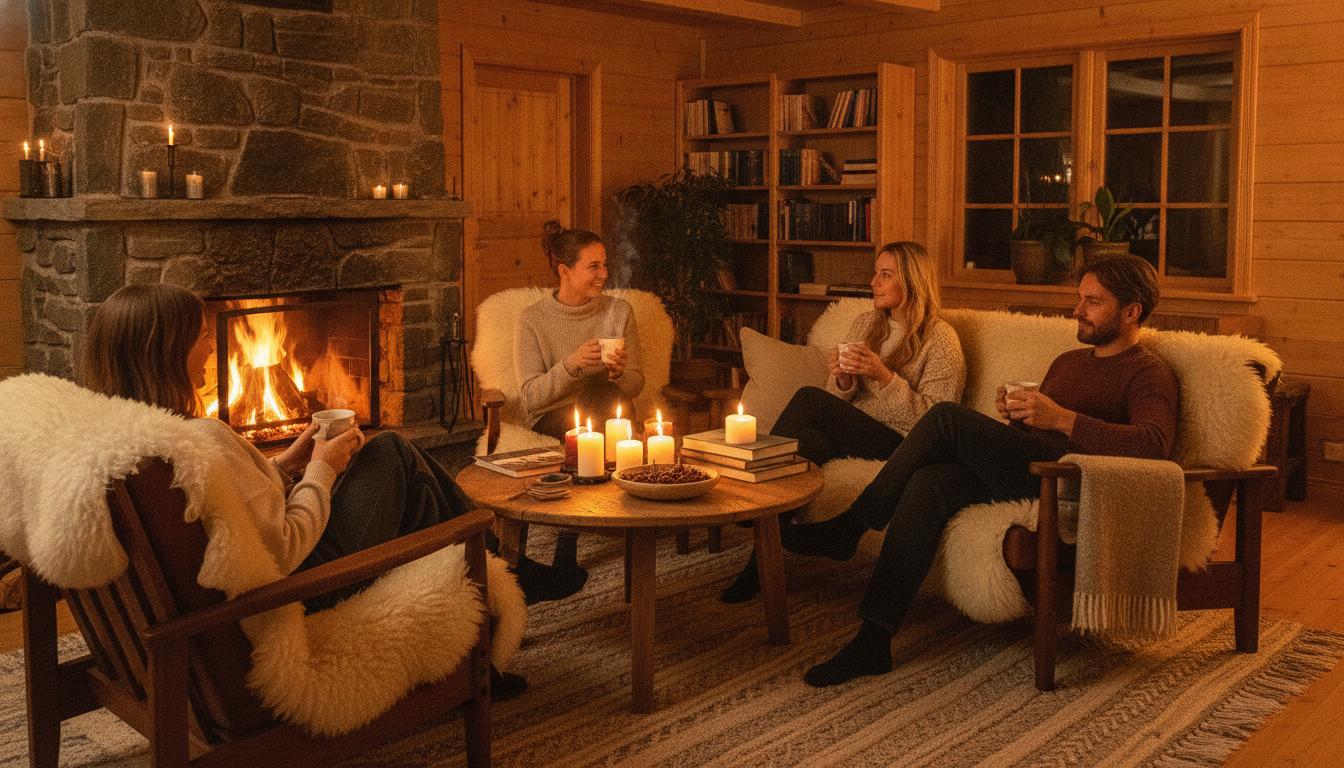
Solveig settled into her armchair, a worn leather thing that seemed to have shaped itself to her contours over the years, and began the conversation with a question. Not a trivial one, the kind that passes for social lubricant at cocktail parties. A real question, the kind that demands a real answer. “What,” she asked, “have you lost this year that you have not yet grieved?”
The room went quiet. Not the uncomfortable silence of a social misstep, but the charged stillness of a door being opened. The physician spoke first. He had lost a patient, he said, a child he had been treating for three years. Not to the disease they had been fighting, but to a complication they had not anticipated. He had not told anyone, not even his wife. He had simply moved on to the next patient, and the next, and the next.
“I did not grieve,” he said, staring into the fire, “because I thought grief was a luxury I could not afford. But I am beginning to understand that ungrieved loss does not disappear. It compounds. It becomes something else, something harder.”

The poet spoke next, and then the furniture restorer, and then the young man from winter maintenance, who surprised everyone by speaking with unexpected eloquence about the death of his grandfather, a reindeer herder from the far north who had taught him everything he knew about silence. “He never spoke much,” the young man said. “But when he did, you listened. Because you knew he had chosen his words with the same care he used to choose which reindeer to follow, which path to take through the snow.”
I watched Solveig as she listened. She did not interject. She did not offer advice. She simply listened, her head tilted slightly, her eyes reflecting the firelight. It occurred to me that this was her gift, the thing that had drawn these people back to her living room week after week, year after year. She had created a space where silence was not awkward and speech was not performative. A space where you could simply be human, in all your broken, beautiful complexity.
“We do not come here to solve each other's problems. We come here to witness them. There is a difference.”
Click any image to view the gallery.
The evening wore on, and the conversation shifted from grief to gratitude, as it often did at these gatherings. Each person named three things they were grateful for. The physician named his wife, his garden, and the fact that he still believed his work mattered. The poet named the sound of snow falling, the smell of old books, and the existence ofSolveig's fireplace. The furniture restorer named her hands, which could still feel the grain of wood, and her daughter, who had recently started university in Bergen.
When it was my turn, I found myself unexpectedly moved. I named the warmth of this room, the generosity of strangers, and the knowledge that somewhere in the world, people still gathered like this, around fires, in the dark, speaking truth to each other. It felt like a prayer, though I am not a religious person. It felt like the kind of thing humans have been doing since we first learned to make fire and sit with it, the kind of thing that makes all the rest of life bearable.
After midnight, the guests began to leave, one by one, wrapping themselves back into their scarves and coats, stepping out into the snow and the cold and the quiet Oslo night. Solveig and Erik walked me to the door, and as I was leaving, she pressed a small candle into my hand. “For your own fire,” she said. “It does not have to be big. Just warm. Just honest.”
I walked home through streets that glistened with new snow, the candle safe in my pocket, the warmth of the evening still radiating through me. And I understood, finally, what hygge really means. It is not about design. It is not about aesthetics. It is about the courage to be present, to be open, to be together. It is about the fire, yes. But more than that, it is about the people who choose to sit beside it.
